


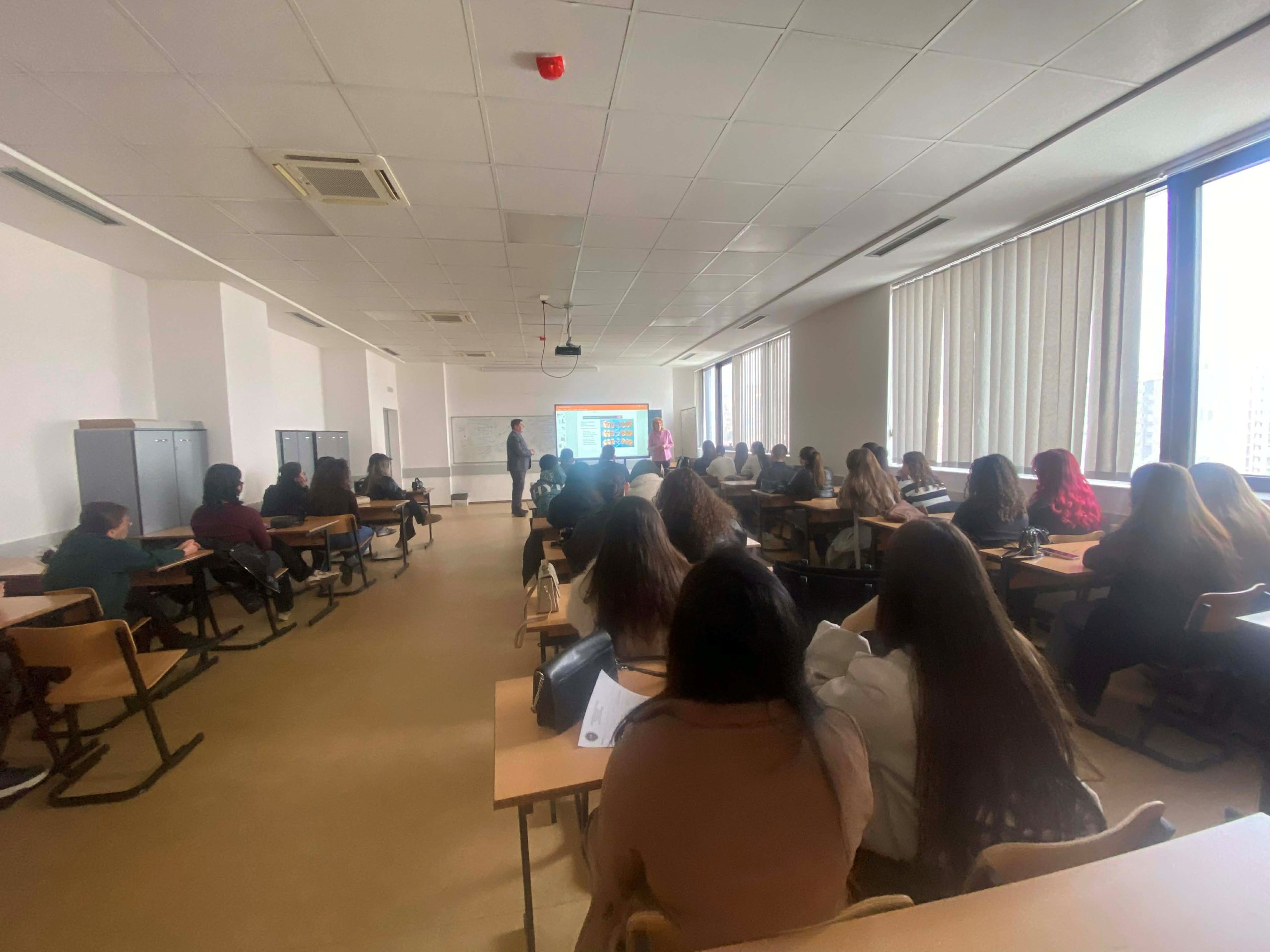
Joint International Lecture at the Faculty of Law of UIBM: Criminal Law and Criminalistics Comparison of Evidence Securing in Sexual Offences
The Faculty of Law of the University “Isa Boletini” in Mitrovica organized a joint academic lecture entitled “Securing Evidence in Criminal Offences against Sexual Integrity – a Criminal Law and Criminalistics Comparison between Germany and Kosovo.” The lecture was delivered by Prof. Dr. Anja Schiemann from the Faculty of Law of the University of Cologne (Germany) and Prof. Dr. Islam Qerimi from the Faculty of Law of UIBM (Kosova).
This lecture was held within the framework of international academic cooperation and aimed to analyze the legal framework and criminalistic practices related to the securing of evidence in cases of criminal offences against sexual integrity, comparing the legal system of Germany with that of the Republic of Kosovo.
In the first part of the lecture, Prof. Dr. Anja Schiemann presented the German legal framework and practical experience regarding the securing of evidence in sexual offences. She emphasized that, from a procedural perspective, the securing of evidence in such cases does not fundamentally differ from the procedures applied in other criminal offences. However, specific legal provisions exist that guarantee the protection of the dignity and integrity of persons involved in the proceedings. Particular attention was given to bodily examinations, the collection of biological traces, and molecular genetic analyses, especially DNA analysis, as well as the practical challenges faced during criminal investigations.
It was highlighted that in many cases of sexual offences there are no eyewitnesses, and therefore the testimony of the victim often becomes the primary piece of evidence in criminal proceedings. Nevertheless, the professional securing of biological traces, proper documentation of injuries, and forensic medical examinations are key elements in establishing the truth and ensuring reliable evidence in court proceedings.
The lecture also addressed the practice of anonymous evidence preservation in Germany, which allows victims of sexual offences to preserve forensic traces without immediately filing a criminal complaint. This mechanism enables the collected evidence to be used later if the victim decides to initiate criminal proceedings.
In the second part of the lecture, Prof. Dr. Islam Qerimi presented an analysis of criminal offences against sexual integrity according to the legislation of the Republic of Kosovo, based on the Criminal Code of the Republic of Kosovo and the Criminal Procedure Code of the Republic of Kosovo. He emphasized that sexual offences are among the most sensitive and complex crimes within the criminal justice system, as the process of securing evidence in such cases often presents significant challenges.
According to him, these challenges are mainly related to the absence of witnesses, the psychological trauma experienced by the victim, delayed reporting of the offence, as well as social factors such as societal stigma and fear of retaliation. For this reason, the professional and standardized collection of evidence is essential for ensuring justice and for the effective prosecution of perpetrators.
In this context, the importance of immediate medical and forensic examination of the victim was emphasized. Such examinations include the documentation of injuries and the collection of biological traces. Possible samples that may be secured in these cases include blood, semen, hair, and skin cells, and these procedures are carried out by forensic medical experts in accordance with professional and scientific standards.
Prof. Qerimi also highlighted the central role of the prosecutor during the investigation phase. The prosecutor leads the investigation, orders the collection of evidence, ensures the legality of the procedure, and protects the rights of the victim. In this context, the prosecutor may request expert examinations, searches, and other investigative actions necessary for clarifying the case.
An important element in such proceedings is also the victim’s statement, which often represents one of the key pieces of evidence. Therefore, questioning must be conducted with particular sensitivity and preferably by specially trained investigators, while avoiding repeated interviews that may lead to secondary victimization. In certain cases, the presence of a psychologist may be included, and interviews may be recorded audiovisually in order to preserve the integrity of the testimony.
Within the framework of victim and witness protection, the legislation of the Republic of Kosovo provides special measures for protecting the identity and privacy of victims. These measures include closed court hearings, protection of personal data, and the prohibition of publishing information that could lead to the identification of the victim.
From a criminalistic and procedural perspective, evidence that may be used in such cases includes medical and forensic evidence, biological evidence through DNA analysis, clothing and physical traces found at the crime scene, digital evidence, witness statements, and expert reports.
In conclusion, the lecture emphasized that securing evidence in criminal offences against sexual integrity requires a combination of high professional standards and particular sensitivity toward victims. The Criminal Procedure Code of the Republic of Kosovo provides important procedural guarantees for the collection and administration of evidence, while close cooperation between the police, the prosecution, and forensic experts is essential for the effective investigation and prosecution of these criminal offences.
This lecture provided an important opportunity for students of the Faculty of Law to become familiar with international experiences and contemporary practices in the fields of criminal law and criminalistics, contributing to the advancement of scientific knowledge and the strengthening of academic cooperation between universities.